
My Journal App Found Its Voice
It wasn't mine. So I built Reverie

I’ve been using Day One for fifteen years. It has been the trusted repository for my thoughts and memories through thick and thin, it’s had a remarkable run. If you’re happy with where it’s going, I’d still recommend it.
Where it’s going is the problem. I wrote recently about the moment Day One began offering to summarise my entries and counsel me about their contents. The app had found a voice, and it wasn’t mine. A journal should remind me of the dead ends, the breakthroughs, the summits, the nadirs — in my words, not somebody else’s precis of them. A journal is a sanctum, and I ended that piece with a question: I’ve built one — would you like to see it?
Here it is.
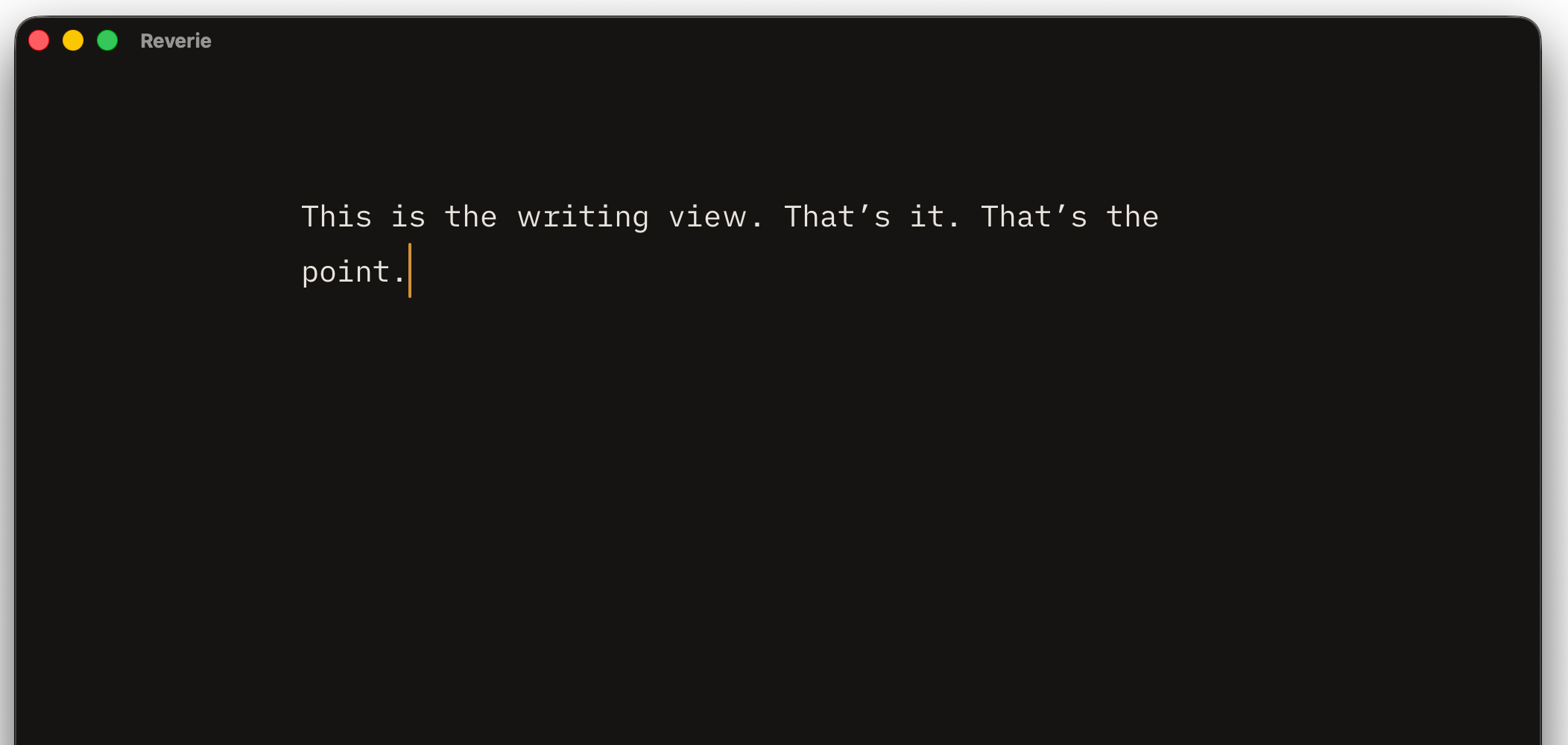
Reverie is a calm place for writing, reflection and, of course, reverie. It’s the first release from Freeholder, a new software label I’ve set up, drawing on decades of development, production and portfolio experience.
Why “Freeholder”?
Because much of today’s software is rented, not owned.
Because software is increasingly mediated — by AI, by servers, by terms and conditions.
Because you should be free to create and hold your own words, without mediation and without the threat of lock-in.
Every Freeholder app will keep to the same promises. No subscription. Your words in plain Markdown files on your own disk, readable by any text editor, in a format that will outlive the software. No account, because there’s nothing to sign into. And no telemetry of any kind — nothing ever phones home, because there is no home to call.
Reverie launches with two features no other journal offers:
Reflect. Reverie opens to Reflect: thoughts and questions drawn from your recent entries, offered back to you to sit with or respond to. Tap one, and you’re in conversation with your past self. Journalling too often feels like hurling your thoughts into the void — Reflect is the continuity that fixes that. Your journal talking back turns out to be an amazing thing, provided the only voice it ever uses is yours. This is done with plain, local code running on your device. No language model, no server, nothing leaves your machine. I’ve nothing against LLMs in their place — but their place is not inside your journal, quietly forwarding your private thoughts to a datacentre in another country.
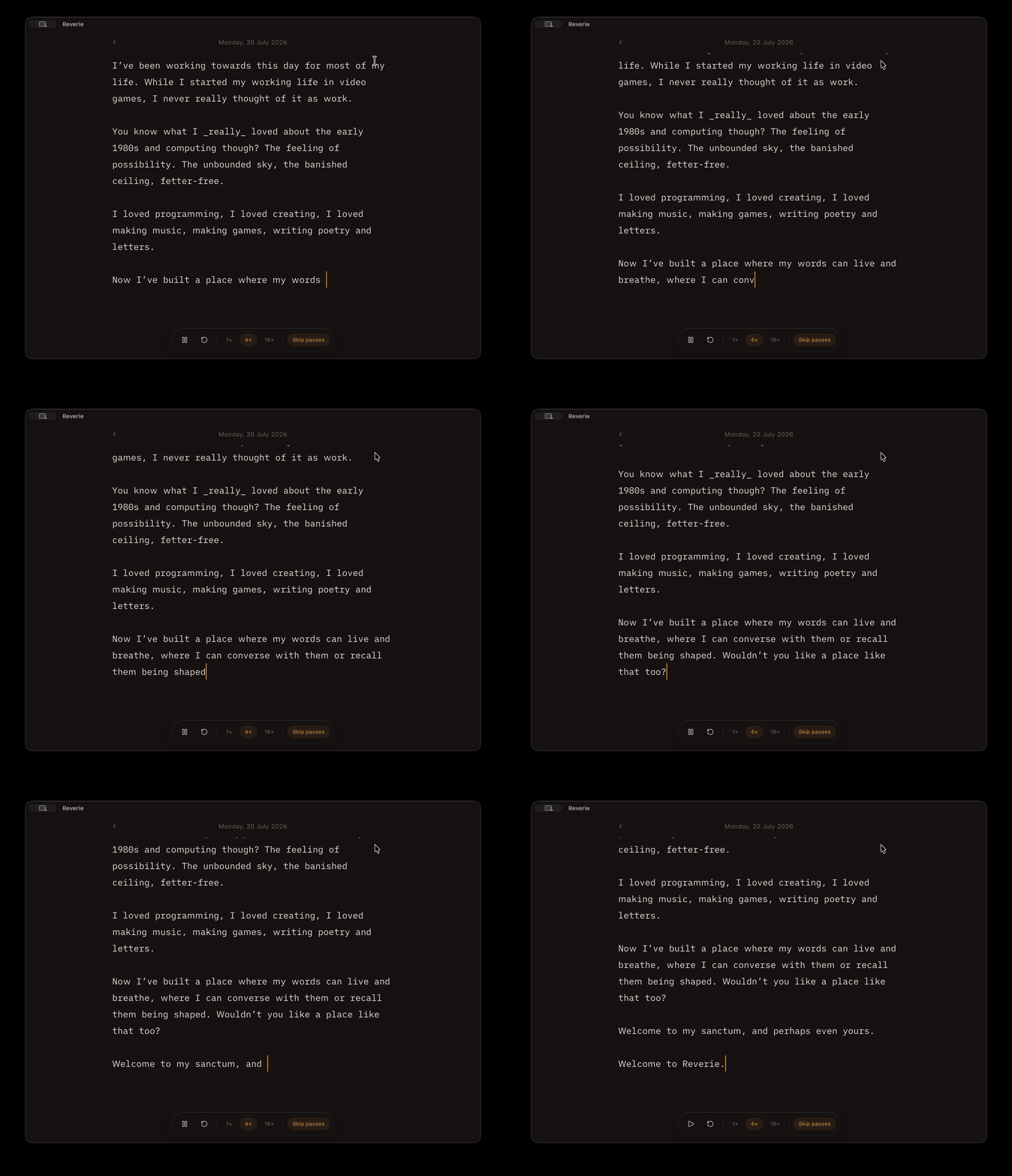
Replay. Your entry plays back exactly as you typed it: mistakes, corrections, pauses and all. It brings a life to old entries that no journal has offered before. (I can assure you the prevalence of the initial letter “R” in Reverie’s feature set is entirely coincidental.) Everything Replay records is stored locally, alongside your words, and nowhere else.
If you’re coming from Day One, Reverie will import your journal — all fifteen years of it, in my case. Import lives quietly in Settings rather than ambushing you on first open. It will also import whole folders of Markdown, so an Obsidian vault walks straight in. And if you ever leave, you take everything with you. That’s not a feature so much as the point.
A word on sync, because the sharp-eyed will have noticed there’s no server to do it. Reverie doesn’t sync, deliberately. Your journal is a folder of files, and files sync however you choose: iCloud Drive if you’re on Apple hardware (do turn on Advanced Data Protection), Syncthing or similar if you’re not. Your journal moves between your devices without ever passing through mine.
Reverie launches on Mac and Windows, with Linux following soon after. Phone and tablet versions are a priority before v2 — I won’t pretend there’s a date yet, but I know exactly how much a journal lives in your pocket. And v2 itself has two features I’m itching to show you: Horizon, your whole journal laid out as a timeline you can wander through, and Postcards, where each entry quietly grows its own botanical artwork from the words you wrote — and you can watch it bloom during Replay.
The current build is with a cohort of eleven generous souls. Once their feedback is in, Reverie opens for early access at £29, which includes every future version, for every platform. From launch proper it’ll be £39, with major upgrades at £10. That’s the entire business model, and it’s how Reverie stays subscription-free: I answer to the people who bought it, not to a renewal rate.
One more thing. With this post, Dancing Monkeys offers paid subscriptions for the first time. Become an annual patron and you get everything Freeholder makes at no extra cost — and whatever ships during your patronage is yours for good, even if you later move on. No strings, no lapse-and-lose. Patronage is a year’s commitment, which is why the software promise belongs to the annual tier; a monthly subscription gets you the writing alone.
Founding Patrons get the one thing money can’t otherwise buy: their name in the credits of every Freeholder app. Every patron tier is at its founding-window price today — the Founding Patron tier, for one, is £100 now and £120 once Reverie reaches launch proper — and Reverie’s own price will step up the same way. Early believers are rewarded on both sides of the house. If you’d rather simply buy the software, I honour that too. And if you’d rather do neither and keep reading for free, you’re more than welcome here.
To hear when Reverie opens up, ask at freeholder.dev — it’s an email to a person, not a mailing-list form, and it will only ever be used to tell you about Freeholder.